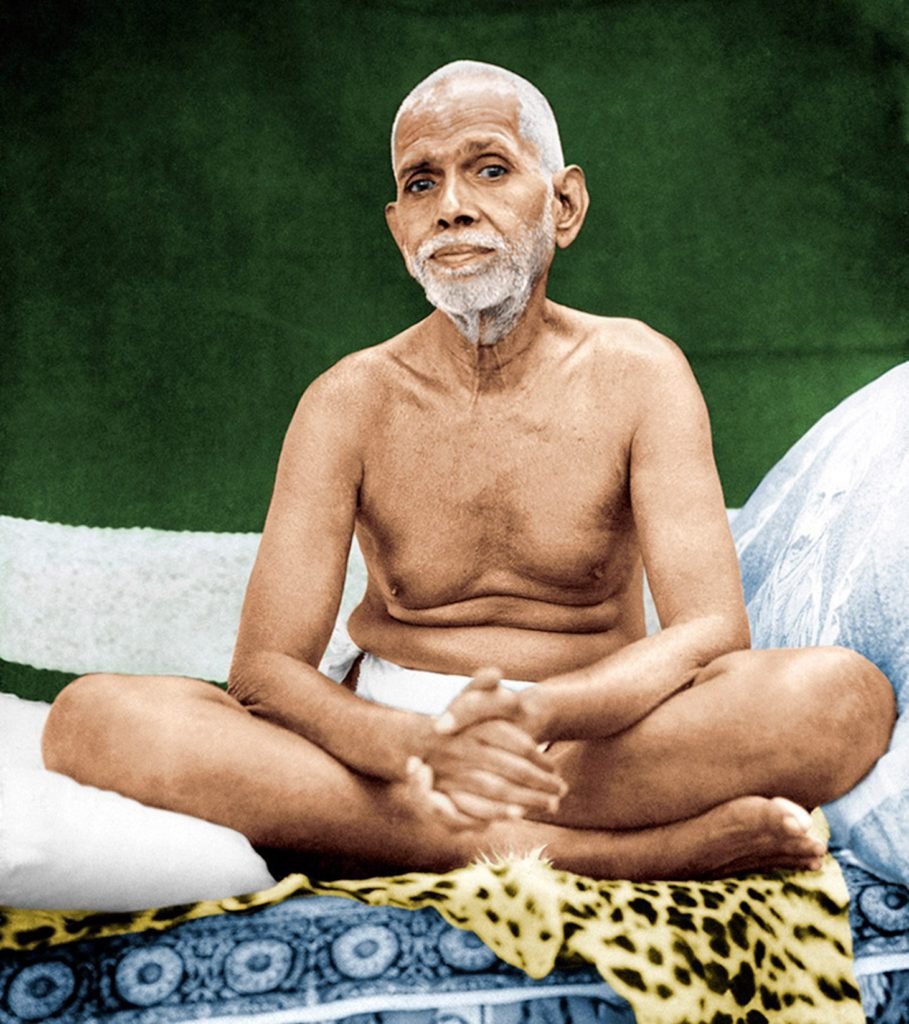
 1879–1950
Sri Ramana Maharshi (1879–1950) was a silent sage of Arunachala whose direct path of self-inquiry (Atma-Vichara)—the question “Who am I?”—points seekers beyond thought to the ever-present Self.
Birth & Early Life
Born Venkataraman Iyer on 30 December 1879 in Tiruchuzhi, Tamil Nadu, he grew up an ordinary boy: playful, inwardly intense, and not particularly religious. After his father’s death, he moved to Madurai, where the very name “Arunachala” stirred in him a deep and mysterious devotion.
Turning Point
At sixteen, he was suddenly overcome by the fear of death. Lying down, he faced the experience directly: If the body dies, what is the “I” that remains aware? In that moment, he realized the Self as timeless, deathless awareness. Shortly after, in 1896, he left home for the sacred hill of Arunachala in Tiruvannamalai, where he lived in silence, meditating in temples and caves.
Teachings & Contributions
People drawn to his natural radiance began to gather around him. Without creating a formal system, he guided seekers to look within and trace the sense of “I” back to its source, until only pure awareness remained. Around him, Sri Ramanasramam grew naturally as a place of meditation, simplicity, and community. His words were few; often his silence, a look, or a simple response carried profound guidance. His talks and writings, including Who am I?, continue to inspire truth-seekers worldwide.
Core Values / Key Message
At the heart of Ramana Maharshi’s teaching is the recognition that the Self is always present and does not need to be attained but only uncovered. His method of self-inquiry — turning attention inward and asking “Who am I?” — dissolves the false sense of ego and reveals the ground of pure awareness. For him, silence was the highest form of instruction, more eloquent than words, and a natural expression of truth. He emphasized living with simplicity, detachment, and compassion, seeing the world as a play in which the Self alone is real.
Legacy
Remaining accessible and unassuming, he welcomed all beings—humans and animals alike—with the same quiet love. He attained Mahanirvana at Sri Ramanasramam on 14 April 1950. To those grieving he said, “I am not going anywhere. Where could I go? I am here.” Today, the path of self-inquiry and the living peace of Arunachala continue to draw seekers from every tradition.